


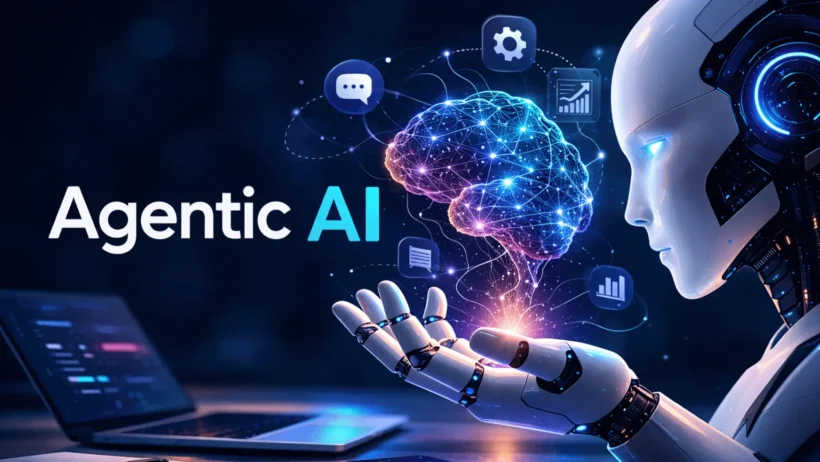

Agentic AI is AI that does more than answer questions. It is built to pursue a goal, plan steps, use tools, and take actions with limited supervision. In plain English, it is the shift from AI that mainly responds to AI that can work through a task. IBM defines agentic AI as a system that can accomplish a specific goal with limited supervision, while Google Cloud describes AI agents as software systems that pursue goals, reason, plan, use memory, and complete tasks on behalf of users.
That is why people are paying attention. This is not just a new label for chatbots. It is a real product and workflow shift. OpenAI is now documenting agent workflows and tooling directly in its platform, Microsoft has been framing the current phase as the “age of AI agents,” Google Cloud has launched an AI Agent Marketplace tied to Gemini Enterprise, and Salesforce is openly talking about the “agentic enterprise.”
The short answer
If you want the simplest definition, use this one: agentic AI is AI that can take a goal and work toward it, not just generate a reply. It usually combines reasoning, planning, memory, tool use, and some level of autonomy. IBM, Google Cloud, and OpenAI all describe this shift in slightly different ways, but they converge on the same idea: agentic systems are built to complete tasks and workflows, not just produce text.
What agentic AI actually means
The term “agentic” comes from the idea of agency. IBM says the word refers to these systems’ capacity to act independently and purposefully. In its architecture guide, IBM also says agentic AI systems can autonomously plan and perform tasks on behalf of a user or another system, making them capable of handling a wider and more complex range of tasks than simple chatbots or retrieval tools.
That matters because a normal chatbot and an agentic system may look similar at first. Both might use a chat box. Both might answer a question. But underneath, an agentic system is usually trying to move a task forward. It may break a job into steps, choose tools, retrieve information, hand work across agents, or adapt when something changes. Google Cloud’s definition is especially clear on this point: agents show reasoning, planning, memory, and autonomy, and can work with other agents on more complex workflows.
How agentic AI works
Most agentic systems follow a loop rather than a single response pattern.
Goal
The system starts with a goal. That might be something like “prepare a client briefing,” “resolve a support issue,” or “update this workflow.” OpenAI’s agents documentation describes agents as systems that intelligently accomplish tasks ranging from simple goals to open-ended workflows.
Planning
Instead of answering immediately, the system often decides what steps are needed. IBM’s architecture guide says an orchestration layer can use an LLM or static workflows to break down and dynamically generate the work needed to solve complex tasks.
Tool use
Then it uses tools. That might mean a browser, a CRM, a database, a document store, or another API. Salesforce describes agentic AI as the technology that powers agents to operate autonomously and interact with humans and systems in a collaborative environment, while Google Cloud describes enterprise agents that integrate with Gemini Enterprise and other business tools.
Memory and adaptation
Finally, it tracks context and adjusts. Google Cloud explicitly includes memory, adaptation, and learning in its definition of AI agents, which is part of what separates agentic AI from rigid automation.
A simple way to think about it is this: a chatbot often answers the next prompt. Agentic AI tries to complete the job.
Agentic AI vs chatbots, copilots, and traditional automation
This is where most confusion comes from, so it helps to put the categories side by side.
| Type | Main job | What it usually does | What it usually does not do |
|---|---|---|---|
| Traditional automation | Follow fixed rules | Executes predefined workflows | Adapt well to new situations |
| Chatbot | Respond in conversation | Answer questions, summarize, draft | Reliably plan and act across many steps |
| Copilot | Assist a human in context | Help inside an app or workflow | Fully drive the workflow on its own |
| Agentic AI | Pursue a goal | Plan, reason, use tools, act, and adapt | Guarantee perfect autonomy or safety |
Gartner makes a useful distinction here. It says AI assistants are precursors to agentic AI: they help users and simplify tasks, but they do not operate independently. Gartner also warns that calling every assistant an agent is a misconception it labels “agentwashing.”
So the real difference is not branding. It is autonomy and workflow depth.
Why everyone is talking about agentic AI right now
Big vendors are pushing it hard
A large part of the buzz is vendor momentum. Microsoft said at Build 2025 that “we’ve entered the era of AI agents.” Google Cloud has built an AI Agent Marketplace connected to Gemini Enterprise. OpenAI is now offering agent tooling, builders, and optimization flows in its API stack. Salesforce is pushing the idea of the “agentic enterprise,” where humans and AI agents work together across business processes.
When all of the largest enterprise software players start building agent platforms, marketplaces, governance layers, and product bundles around the same idea, the term moves from niche research language into mainstream business language.
Enterprises want AI that does work, not just talks
The first generative AI wave made people comfortable with chat interfaces. The next demand is obvious: can the AI actually finish something useful? MIT Sloan reports that a spring 2025 MIT Sloan Management Review and BCG survey found 35% of respondents had already adopted AI agents, with another 44% planning to deploy them soon. MIT Sloan also notes that large vendors are accelerating adoption by embedding agentic capabilities directly into their platforms.
That explains the conversation shift. Businesses are moving from “Can AI help me write this?” to “Can AI help me run this process?”
The market expects agents inside business software
Gartner predicts that 40% of enterprise applications will include integrated task-specific AI agents by the end of 2026, up from less than 5% in 2025. It also predicts that by the end of 2025, the vast majority of enterprise apps will have embedded AI assistants, which it describes as the step before more fully agentic software.
That kind of forecast does not prove every agent launch will succeed. But it does show why the term keeps showing up in product announcements, investor conversations, and software roadmaps.
Where agentic AI is actually useful
The strongest use cases are not magical. They are practical.
Salesforce describes an agentic enterprise as one where agents handle repetitive and time-consuming work so humans can focus on higher-value tasks. Google Cloud’s marketplace examples include tax compliance, document analysis, site selection, mortgage payoff analysis, and network troubleshooting. OpenAI frames agents around task completion and workflow orchestration rather than one-off answers.
That points to a handful of clear use cases:
- customer support triage and resolution
- research and briefing preparation
- document extraction and synthesis
- compliance and operations workflows
- software and DevOps assistance
- internal workflow automation across apps
The common thread is not “AI replaces people.” It is “AI handles more of the process.”
Why the excitement comes with real risks
The hype is not the whole story.
MIT Sloan says organizations still face serious challenges around data quality, governance, trust, and security, and many companies do not yet fully understand how to use AI agents well. Google Cloud’s marketplace pitch highlights governance and control because those are real enterprise concerns, not nice extras. Microsoft’s recent security blog is also centered on observing, securing, and governing agents, which tells you how seriously large vendors take the risk side of the equation.
The practical risks are fairly clear:
- agents can take wrong actions, not just generate wrong text
- security and permissions become much more important
- debugging multi-step behavior is harder than reviewing a single answer
- organizations can mistake “assistant features” for real agent capability
That does not make agentic AI overhyped by default. It just means useful autonomy needs stronger guardrails than a chatbot does.
The practical takeaway
So, what is agentic AI and why is everyone talking about it?
It is AI built to pursue goals, use tools, plan work, and act with limited supervision. People are talking about it because major software vendors are now shipping agent platforms, enterprises want systems that do more than chat, and the market increasingly expects business software to include agent-style workflows. IBM, Google Cloud, OpenAI, Microsoft, Salesforce, MIT Sloan, and Gartner are all describing different parts of the same shift.
The clearest way to read the trend is this: generative AI made AI useful at the level of content. Agentic AI is trying to make AI useful at the level of work.
FAQs
Is agentic AI the same as an AI agent?
Not exactly. “AI agent” usually refers to the software system or component that performs the task. “Agentic AI” is the broader idea of AI systems that can pursue goals, plan, use tools, and act with some autonomy. IBM and Google Cloud both describe it as goal-driven, low-supervision AI built from or around agents.
How is agentic AI different from a chatbot?
A chatbot mainly responds to prompts. Agentic AI is designed to work toward an outcome, often by reasoning through steps, using tools, and adapting along the way. Gartner also distinguishes assistants from agents, warning that many products are mislabeled as agents when they are really just assistants.
Why is agentic AI suddenly everywhere?
Because the largest software vendors are embedding it directly into products, and enterprise buyers increasingly want AI that can complete workflows instead of just generating content. MIT Sloan’s coverage of the 2025 MIT SMR/BCG survey and Gartner’s enterprise app forecast both point to that shift.
Is agentic AI already mature?
Not fully. The technology is advancing quickly, but MIT Sloan notes that understanding of how to deploy it well is still early, and governance, security, and trust remain major concerns.


[…] being formalized more openly. Anthropic announced in December 2025 that it was donating MCP to the Agentic AI Foundation, a directed fund under the Linux Foundation, co-founded by Anthropic, Block, and OpenAI, […]
[…] overall AI automation plugin: Bit […]