


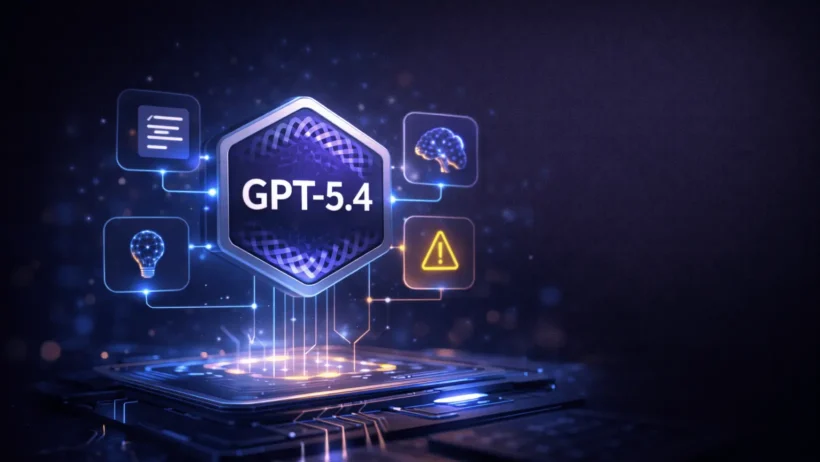

GPT-5.4 is OpenAI’s flagship model for complex professional work. In plain English, it is the version of GPT built to handle harder reasoning, stronger coding, longer inputs, and more reliable multi-step workflows than earlier mainline models. OpenAI released it in ChatGPT as GPT-5.4 Thinking, and also made it available in the API and Codex.
The fastest way to understand GPT-5.4 is this: it is less about casual chat and more about real work. OpenAI positions it as the default model for broad general-purpose work and most coding tasks, especially when one workflow mixes writing, analysis, reasoning, tool use, and software work.
What GPT-5.4 actually is
GPT-5.4 is a frontier model in the GPT-5 family. OpenAI describes it as its most capable and efficient model for professional work, with improvements in coding, document understanding, instruction following, long-running task execution, tool-heavy workflows, and multi-source synthesis.
It is also a model designed for agents, not just chat. OpenAI says GPT-5.4 supports long-horizon work, tool search, computer use, custom tools, and large-context analysis, which makes it a better fit for workflows where the model needs to do more than answer one question.
GPT-5.4 at a glance
| Area | GPT-5.4 quick facts |
|---|---|
| Main role | OpenAI’s default flagship model for complex reasoning, coding, and professional work |
| Availability | ChatGPT, API, and Codex |
| Context window | 1M tokens in the guide, 1.05M on the model page |
| Input and output | Text and image input, text output |
| Reasoning settings | None, low, medium, high, xhigh |
| Notable tools | Web search, file search, code interpreter, computer use, MCP, tool search |
| Knowledge cutoff | August 31, 2025 |
| API price | $2.50 per 1M input tokens, $15 per 1M output tokens |
| Important caveats | Audio and video not supported on the model page, fine-tuning not supported |
These details come from OpenAI’s current model, pricing, and GPT-5.4 guidance pages.
The features that matter most
Stronger reasoning and coding
OpenAI says GPT-5.4 improves on GPT-5.2 in coding, tool use, document understanding, instruction following, and long-running task execution. It is also the model OpenAI recommends when you want one system that can move between software engineering, reasoning, writing, and tool use in the same workflow.
That makes GPT-5.4 especially useful for work that does not fit into one box. You can use it to plan a feature, inspect a repo, draft documentation, review a spreadsheet, and then verify the result with tools, all inside one broader workflow. That is the core reason GPT-5.4 matters more to teams than to casual users.
1M token context
One of the biggest practical upgrades is context length. OpenAI says GPT-5.4 supports up to a 1M token context window, and the model page lists it as 1,050,000 tokens. In real use, that means you can feed it large codebases, long document sets, or extended agent histories without chopping everything into tiny pieces first.
This is not just a bragging number. Large context matters when the model needs to keep track of requirements across many files, compare multiple documents, or stay coherent through a long multi-step task.
Built-in computer use and tool search
GPT-5.4 is the first mainline OpenAI model with built-in computer-use capabilities. OpenAI says it can inspect screenshots and return structured actions so an external harness can operate software, fill forms, navigate websites, and verify results through a build-run-verify-fix loop.
It also introduces tool_search, which is designed for large tool ecosystems. Instead of loading every tool definition at once, GPT-5.4 can search for the relevant tools at runtime. OpenAI says that helps reduce token usage, improve latency, and make tool selection more accurate in real deployments.
Better control for structured work
GPT-5.4 also supports custom tools, structured outputs, function calling, and reasoning controls. OpenAI’s prompt guidance says the model is especially strong when the output contract is explicit and the workflow is structured clearly. It also notes better tone adherence, better evidence-rich synthesis, and stronger performance on long-context analysis.
That is a big deal for production use. Many AI failures happen because the model drifts, gets verbose, skips steps, or ignores format rules. GPT-5.4 is meant to be easier to steer when the task is defined well.
Real GPT-5.4 use cases
Software development
GPT-5.4 is a strong fit for software teams. OpenAI says it brings the coding strengths of GPT-5.3-Codex into a flagship general model, with support for multi-file changes, repo-specific patterns, and production-quality code generation. It is also the newest model powering Codex and Codex CLI.
A practical example would be asking GPT-5.4 to inspect a codebase, propose a fix, update several files, generate tests, and then use tools to verify whether the patch works. That is the kind of end-to-end workflow GPT-5.4 is built for.
Research and document analysis
GPT-5.4 is also built for document-heavy work. OpenAI highlights long-context analysis, evidence-rich synthesis, better document parsing, and stronger performance on customer service, analytics, and finance workflows that depend on large, messy, or multi-document inputs.
This makes it a useful model for reading contracts, summarizing long reports, comparing policies, extracting key findings from research materials, or turning scattered notes into something structured and actionable.
Spreadsheets, presentations, and business workflows
OpenAI also put visible emphasis on real office work. In the launch post, it says GPT-5.4 was improved for creating and editing spreadsheets, presentations, and documents. It also reported better performance than GPT-5.2 on its internal spreadsheet modeling tasks and stronger human preference scores for presentation outputs.
That does not mean it replaces analysts, designers, or operators. It means GPT-5.4 is more useful for the messy middle of business work, where the job is not just to answer a question but to produce a polished work product.
Agentic workflows
If you build automations or AI agents, GPT-5.4 is one of the clearest examples of where the model is supposed to shine. OpenAI says it is more token-efficient on tool-heavy workloads, better at long-running execution, stronger at agentic web search, and more reliable across multi-step trajectories.
That makes it suitable for workflows like research agents, browser automation, support copilots, internal knowledge assistants, or tool-using systems that need to retrieve data, reason over it, take actions, and then verify the result.
GPT-5.4 limitations you should know
GPT-5.4 is more capable, but it is not perfect. OpenAI’s own prompt guidance says explicit prompting still matters for low-context tool routing, dependency-aware workflows, research tasks that need disciplined citations, terminal or coding-agent environments, and irreversible or high-impact actions. In other words, GPT-5.4 is stronger, not magically self-correcting.
It also still needs verification. OpenAI’s safety and prompting guidance says high-impact actions should be checked before execution, and the computer use guide recommends running GPT-5.4 in an isolated browser or VM with a human in the loop for serious actions.
There are also product limits. On the API model page, GPT-5.4 supports text and image input with text output, but audio and video are not supported for the model itself. The same page also says fine-tuning is not supported.
Cost is another real limitation. GPT-5.4 is not OpenAI’s cheapest option. The API pricing page lists it at $2.50 per 1M input tokens and $15 per 1M output tokens, and OpenAI says very large prompts above 272K input tokens are charged at higher rates for 1.05M-context models. That means GPT-5.4 makes more sense when the quality of the work matters enough to justify the cost.
Finally, it is not fully up to date on its own. OpenAI’s model page lists an August 31, 2025 knowledge cutoff, which means fresh facts still require web access or another grounding source.
Who should use GPT-5.4
GPT-5.4 makes the most sense for people who need one strong model for serious work across several task types. That includes developers building agents, teams working with long documents or large codebases, and businesses that want more reliable structured outputs for analysis, operations, research, and content production.
It is less compelling when your main priority is the lowest possible cost or the fastest lightweight response. OpenAI’s own model selection page says smaller variants like GPT-5 mini are the better choice when latency and cost matter more than top-end capability.
How to get better results from GPT-5.4
The best way to use GPT-5.4 is to be explicit. OpenAI recommends choosing the right reasoning effort for the task, defining what “done” looks like, using clear output contracts, and relying on tools when they improve correctness or grounding.
In practice, that means a few simple habits help a lot:
- tell GPT-5.4 exactly what output format you want
- use tools for retrieval, search, and verification when facts matter
- keep a human review step for anything high-impact
- use bigger reasoning only when the task actually needs it
- avoid assuming long context removes the need for structure
Final takeaway
So, what is GPT-5.4? It is OpenAI’s current flagship model for real professional work: stronger at reasoning, better at coding, more capable with long context, and more useful for tool-using, multi-step workflows than earlier mainline GPT models.
Its real value is not that it talks better. Its value is that it can stay on task across harder work. At the same time, GPT-5.4 still has clear limits around cost, current knowledge, tool reliability in thin-context situations, and high-risk autonomy. If you treat it like a strong assistant instead of a flawless operator, it becomes much easier to use well.
FAQs
Is GPT-5.4 available in ChatGPT?
Yes. OpenAI released GPT-5.4 in ChatGPT as GPT-5.4 Thinking, and also made it available in the API and Codex.
What is GPT-5.4 best for?
OpenAI positions GPT-5.4 as the default model for complex reasoning, coding, long-context analysis, and multi-step professional workflows that mix writing, tools, and structured outputs.
Does GPT-5.4 support image input?
Yes. OpenAI’s model docs list text and image as supported inputs, with text output. The same page says audio and video are not supported for GPT-5.4.
Can GPT-5.4 be fine-tuned?
No. OpenAI’s GPT-5.4 model page currently lists fine-tuning as not supported.


[…] GPT-5.4 […]
[…] GPT-5.4 for mixed professional tasks and agent-style […]