


If you want your content to rank, keywords still matter. But keywords alone are not enough.
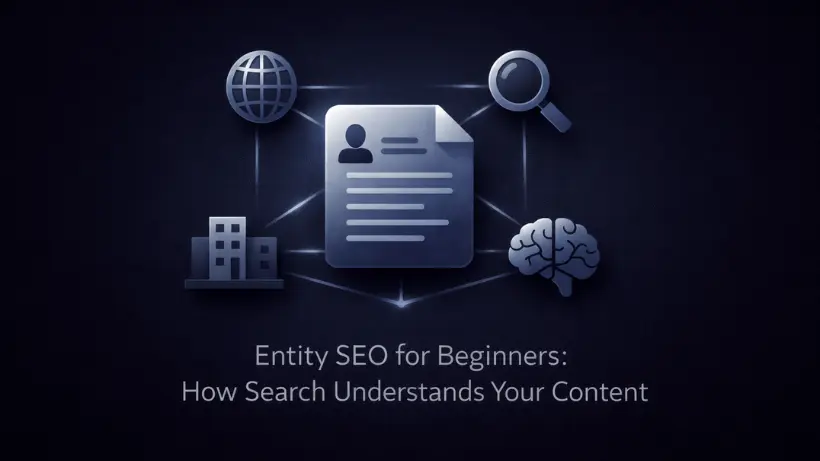
Search engines try to understand what your page is actually about, not just which words appear on it. That is where entity SEO comes in. It helps search connect topics, people, brands, places, products, and ideas so your content makes sense at a deeper level.
For beginners, the simplest way to think about entity SEO is this: stop writing pages that only repeat a keyword, and start building pages that clearly explain a topic in context.
Table of Contents
What Is Entity SEO?
Entity SEO is the practice of making your content easier for search engines to understand by clearly expressing the main things your page talks about and how those things relate to each other.
An entity is a thing with a clear identity. It can be:
- a person
- a company
- a place
- a product
- an event
- a concept
“Tesla” is an entity. “New York City” is an entity. “Search engine optimization” can also be treated like an entity when search systems can identify it as a concept.
What counts as an entity
Search engines do not just see words. They try to map those words to known things.
For example, if your page mentions “Apple,” search needs to decide whether you mean:
- Apple the company
- apple the fruit
- Apple products like the iPhone or MacBook
That decision depends on context. If your page also mentions Tim Cook, iOS, Mac, and App Store, the meaning becomes clear.
How entity SEO differs from keyword-only SEO
Old-school SEO often focused too narrowly on repeating exact phrases.
Entity SEO takes a broader view. It asks:
- What is the central topic?
- What related concepts should appear?
- What supporting details make the meaning clear?
- What real-world relationships help search understand the page?
So instead of forcing one keyword 20 times, you build a page that naturally covers the topic well.
How Search Engines Understand Content
Search engines try to identify three things when they read your page:
- Entities
- Attributes of those entities
- Relationships between them
Entities, attributes, and relationships
Let’s say your article is about the iPhone 15.
Search may identify:
- Entity: iPhone 15
- Attributes: smartphone, Apple product, camera, battery, USB-C
- Relationships: made by Apple, compared with Samsung Galaxy devices, sold in certain markets
This helps search move beyond matching words. It starts building a topic map of your page.
Why context matters
Context tells search what role an entity plays on the page.
If you mention “Java,” are you talking about:
- the programming language
- the island in Indonesia
- coffee
Search looks at nearby words, headings, internal links, structured data, and the overall page topic to understand which one you mean.
That is why clear writing is good SEO. It removes confusion.
How search resolves ambiguity
When terms can mean more than one thing, search uses surrounding signals to disambiguate them.
Helpful signals include:
- descriptive headings
- related terms used naturally
- internal links to relevant supporting pages
- author and site context
- structured data when appropriate
The clearer your page is, the easier it is for search to connect it to the right entity.
Why Entity SEO Matters for Beginners
You do not need a huge site to benefit from entity SEO. In fact, beginners often improve faster when they learn this early.
Better topical clarity
A page that clearly explains one topic with the right supporting concepts is easier to understand and easier to rank than a vague page trying to target ten ideas at once.
Stronger relevance signals
When your content includes the right related entities, search gets more confidence about what the page covers.
For example, a page about email marketing should naturally connect with terms like:
- segmentation
- automation
- open rates
- click-through rate
- deliverability
- email list
That does not mean stuffing those terms. It means covering the topic in a complete and natural way.
More helpful content for real readers
This is the best part. Entity SEO usually leads to better writing.
When you focus on meaning, context, and relationships, your content becomes clearer for people too. Readers stay oriented. They get answers faster. They trust the page more.
Entity SEO vs Traditional Keyword SEO
You do not need to choose one or the other. Good SEO uses both.
| Approach | Main Focus | Strength | Limitation |
|---|---|---|---|
| Traditional keyword SEO | Specific search phrases | Helps match user queries | Can become repetitive or shallow |
| Entity SEO | Meaning, context, and relationships | Improves topical understanding | Can feel abstract if not applied practically |
| Best approach | Keywords plus entities | Stronger clarity and relevance | Requires better planning |
Where keywords still matter
Keywords still help with:
- titles
- headings
- search intent alignment
- anchor text
- on-page clarity
You still need to know what people search for.
Where entity thinking adds depth
Entity SEO helps you move from “mentioning a term” to “explaining a topic.”
That is what makes content stronger in competitive spaces.
How to Optimize Content with Entity SEO
You do not need advanced software to start. Most of the work happens in your planning and writing.
1. Start with the main topic and search intent
Pick one clear page topic.
Ask:
- What is the core entity or concept here?
- What does the reader want to know?
- Is this page meant to explain, compare, review, or teach?
For this article, the main entity is “entity SEO” as a concept. The intent is informational. So the content should explain the idea clearly and show how to apply it.
2. Cover related entities naturally
Once you know the main topic, identify the concepts that belong around it.
For entity SEO, related terms include:
- semantic SEO
- search intent
- structured data
- schema markup
- internal linking
- knowledge graphs
- topical relevance
- content optimization
You do not need to force all of them into every page. Use the ones that genuinely help explain the topic.
3. Add context, not fluff
A page becomes stronger when it explains relationships.
Instead of saying:
“Entity SEO is important for SEO performance.”
Say:
“Entity SEO helps search engines connect your page to a broader topic by identifying the main concept, its related terms, and its real-world context.”
That second version carries more meaning.
4. Use internal links to reinforce meaning
Internal links help search understand how topics connect across your site.
If you publish a page about technical SEO, and you also have pages on crawl budget, indexing, canonical tags, and site architecture, linking them together strengthens your topical structure.
This is one of the easiest ways to support entity SEO without overcomplicating anything.
5. Use structured data where it makes sense
Structured data can help search interpret certain page elements more clearly.
Depending on the page, that might include:
- Article
- FAQ
- Product
- Organization
- Person
- Breadcrumb
Important point: structured data helps with clarity, but it does not replace good content. Adding schema to a weak page does not make the page strong.
A Simple Example of Entity SEO in Action
Let’s say you are writing about electric cars.
Weak version
“Electric cars are popular. Electric cars are efficient. Electric cars are changing the market. Electric cars have many benefits.”
This repeats the phrase, but says very little.
Stronger entity-focused version
“Electric cars use battery-powered drivetrains instead of internal combustion engines. Buyers often compare range, charging speed, battery life, price, and access to charging stations before choosing a model. Brands like Tesla, Hyundai, and Ford compete in different segments, from budget-friendly EVs to premium performance vehicles.”
Now the topic is much clearer.
The page introduces:
- the main concept
- related entities
- buying factors
- connected brands
- category language
That gives both readers and search engines more useful signals.
Common Entity SEO Mistakes to Avoid
Chasing terms without defining the topic
Some pages mention many related phrases but never make the main subject clear. That confuses search and the reader.
Lead with the core topic. Support it with relevant detail.
Stuffing related words
Adding every “semantic keyword” you can find does not make the page smarter. It usually makes it worse.
Use related entities naturally. If a term does not help the reader, leave it out.
Using schema without improving the page
Schema markup is useful, but it is not magic. If the content is thin, unclear, or off-intent, schema will not fix that.
Covering too many intents on one page
A beginner guide, a product comparison, and a service page should not all live inside one confused article.
Match one page to one dominant purpose.
A Beginner-Friendly Entity SEO Checklist
Before publishing, ask yourself:
- Is the main topic obvious in the title and intro?
- Does the page answer the core question early?
- Have I included the most relevant related concepts?
- Are the relationships between ideas clear?
- Do headings guide the topic logically?
- Are internal links supporting the subject?
- Is the content written for understanding, not just keyword placement?
- Have I used structured data only where appropriate?
If the answer is yes to most of these, you are already applying entity SEO better than many beginners.
Final Thoughts
Entity SEO for beginners does not need to feel technical or intimidating.
At its core, it is about clarity.
When your page clearly defines its topic, uses relevant supporting concepts, and shows how ideas connect, search has a better chance of understanding your content correctly. That is the real goal of entity SEO.
So the next time you write, do not just ask, “Did I use the keyword?”
Ask, “Would a search engine and a human both understand exactly what this page is about?”
That question leads to better content every time.
FAQs
Do keywords still matter in entity SEO?
Yes. Keywords still help signal what users are searching for. Entity SEO builds on that by improving topic understanding and context.
Is schema markup required for entity SEO?
No. It helps in some cases, but it is not required. Strong content structure and clear topic coverage matter first.
What is the easiest way to find related entities?
Start with the main topic, then list the people, products, concepts, tools, and terms naturally connected to it. Search results, headings, and top-ranking pages can also reveal useful patterns.
Can entity SEO help small blogs?
Yes. Small sites often benefit because clear topical structure can make their content easier to understand and easier to trust.