

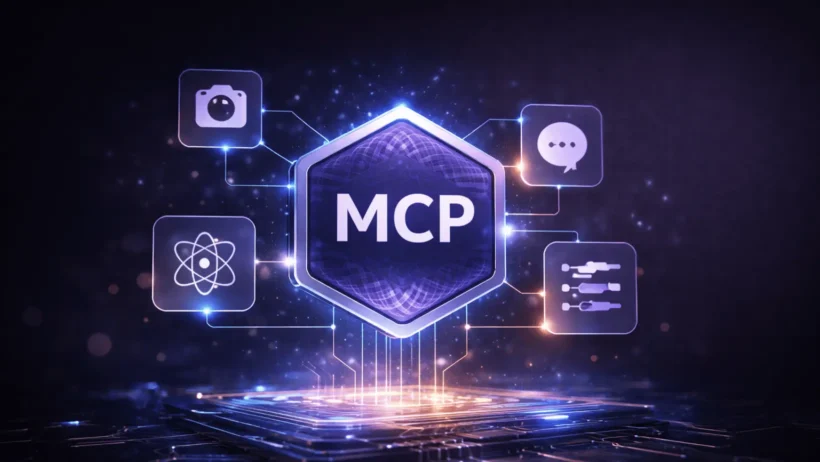

MCP stands for Model Context Protocol. It is an open protocol for connecting AI applications to external tools, data sources, and reusable prompts in a standardized way. The practical point is simple: instead of building a separate custom integration for every model and every app, MCP gives developers one shared way to expose capabilities to AI systems.
The official MCP specification describes it as an open protocol for seamless integration between LLM applications and external data sources and tools. Anthropic, which introduced MCP, describes it as an open standard for connecting AI assistants to the systems where data lives.
That is why MCP matters for AI tools. It is not just another buzzword. It is infrastructure. When an AI tool needs access to docs, files, APIs, design systems, code repositories, or business software, MCP gives it a common language for discovering and using those things.
OpenAI’s current documentation says MCP connects models to tools and context, and can be used to give Codex access to third-party documentation or developer tools such as a browser or Figma.
The short answer
If you want the fastest definition, use this one: MCP is a standard way for AI tools to plug into outside systems without every connection being built from scratch.
Instead of wiring each model to each app manually, developers can expose tools, resources, and prompts through an MCP server, and compatible AI clients can use them in a predictable way. That is the core reason it matters. It reduces integration friction and makes AI tools more portable.
What MCP actually is
MCP is best understood as an interface standard. The official specification says MCP follows a client-host-server architecture. A host application can run one or more MCP clients, and those clients connect to MCP servers that expose capabilities the AI can use.
The spec also says MCP is built on JSON-RPC and provides a stateful session protocol for context exchange and coordination.
That makes MCP less like a single product and more like a shared wiring standard. The spec breaks the server side into three main building blocks:
- Tools, which are executable functions the model can call
- Resources, which are structured data or content the model can read as context
- Prompts, which are reusable templates or instructions the client can fetch and use
This is one reason MCP has spread so quickly. It does not try to dictate one user interface or one model vendor. It standardizes the exchange layer.
How MCP works
Hosts, clients, and servers
In MCP, the host is the app the user actually uses. That could be an IDE, a desktop assistant, a chat app, or a business tool. Inside the host, one or more MCP clients connect to MCP servers, which provide the actual tools and context. The official architecture page says this separation helps maintain clear security boundaries and isolate concerns across applications.
Tools, resources, and prompts
Tools are the action layer. Resources are the context layer. Prompts are the reusable instruction layer. The spec’s server overview says tools let models perform actions or retrieve information, resources share structured context such as files or schemas, and prompts expose predefined templates that can be customized and reused.
That split matters because it reflects how real AI apps work. Sometimes the model needs to do something. Sometimes it needs to read something. Sometimes it needs a trusted workflow template.
Transports and sessions
MCP currently defines standard transports such as stdio and Streamable HTTP, and the protocol lifecycle includes initialization, operation, and shutdown. The latest spec also includes an authorization framework for HTTP-based transports, and the tools guidance says there should always be a human in the loop with the ability to deny tool invocations for trust and safety.
That is an important detail. MCP is not only about capability. It is also about control.
Why MCP matters for AI tools
The biggest reason MCP matters is that AI tools are moving from isolated chat interfaces toward tool-using, context-aware systems. Once an AI assistant needs access to file systems, ticketing tools, design tools, internal docs, or cloud services, custom integrations become expensive and messy.
MCP offers a standard way to handle that complexity. OpenAI’s Responses API guide says hosted MCP tools make it easier to scale and manage model access to services without manually wiring each function call to specific systems.
It also matters because MCP separates model logic from integration logic. The Python SDK overview says MCP standardizes how applications provide context to LLMs while separating the concern of providing context from the actual LLM interaction. That separation makes AI tools easier to extend, swap, and maintain.
A simple way to think about it is this:
| Without MCP | With MCP |
|---|---|
| Every app-model connection tends to be custom | One protocol can work across many apps and models |
| Tool definitions vary by vendor or product | Tools, resources, and prompts follow a shared structure |
| Switching platforms can mean rebuilding integrations | Compatible clients can reuse the same server patterns |
| Governance is often ad hoc | The protocol includes capability negotiation, auth patterns, and clearer boundaries |
Those benefits are why MCP matters more as AI tools become more agentic and more deeply connected to business systems.
How MCP is different from one-off integrations
A one-off integration can work fine for a single product. The problem shows up when you need the same capability across many tools. Anthropic’s original announcement framed MCP as a response to fragmented integrations across content repositories, business tools, and development environments.
The pitch was that one open standard is more scalable than writing a different connector for every app-model pair.
That is also how OpenAI now describes it. Its Apps SDK docs say MCP is the open specification for connecting large language model clients to external tools and resources, and that ChatGPT Apps use MCP so tools can expose both functionality and UI metadata in a standardized way.
So the difference is not just technical elegance. It is ecosystem leverage.
Why everyone is talking about MCP right now
There are three big reasons.
First, MCP is no longer just an Anthropic-side concept. OpenAI now documents MCP for Codex, ChatGPT Apps, deep research, and API integrations. Microsoft also has MCP documentation across .NET, Windows, Microsoft Learn, Azure DevOps, Graph, and Azure MCP Server materials. That kind of multi-vendor support is a strong signal that the protocol has moved beyond a niche experiment.
Second, the standard is now being formalized more openly. Anthropic announced in December 2025 that it was donating MCP to the Agentic AI Foundation, a directed fund under the Linux Foundation, co-founded by Anthropic, Block, and OpenAI, with support from Google, Microsoft, AWS, Cloudflare, and Bloomberg. That kind of governance move matters because standards tend to gain trust when they are not controlled by one vendor alone.
Third, the spec itself is evolving quickly. The latest public MCP spec revision is dated 2025-11-25, and the changelog shows active additions such as improved authorization discovery and new metadata support. It also marks some newer features, like tasks, as experimental. That tells you two things at once: MCP is real, and MCP is still maturing.
Where MCP is already showing up
MCP is already visible in real products and platforms, not just spec documents.
OpenAI says Codex supports MCP servers in both the CLI and IDE extension, and its API docs say remote MCP servers can be used with ChatGPT Apps, deep research, and API integrations. ChatGPT Apps themselves now implement the MCP Apps standard for UI integration.
Microsoft’s ecosystem shows another side of adoption. Microsoft Learn now offers a remote MCP server for official docs and code samples, Azure DevOps has an MCP server for work items, builds, and pull requests, and Microsoft Graph has an MCP Server for Enterprise in preview. Microsoft also documents MCP support in .NET and on Windows.
That matters because it shows MCP is becoming a real connective layer for developer tools, knowledge tools, and enterprise systems.
What MCP does not solve on its own
MCP is useful, but it is not magic.
It does not automatically make an AI tool smart, secure, or reliable. The protocol can standardize how capabilities are exposed, but the quality of the server, the permission model, and the client’s safety choices still matter. The tools spec explicitly recommends human oversight for tool invocations, and the authorization spec makes clear that auth is part of the transport-level story for HTTP-based implementations.
It also does not freeze the ecosystem. MCP is still evolving, and some features remain experimental. So while it already matters, it is still early enough that teams should expect changes and refinement.
Final takeaway
So, what is MCP and why does it matter for AI tools?
It is an open protocol for connecting AI systems to tools, resources, and prompts in a standardized way. It matters because AI tools are becoming less useful as standalone chat boxes and more useful as systems that can read context, call tools, and interact with real software. MCP gives that shift a common integration layer. Anthropic introduced it, OpenAI and Microsoft now support it in multiple products and docs, and the protocol is moving toward broader neutral stewardship under the Linux Foundation’s Agentic AI Foundation.
The simplest takeaway is this: MCP is becoming part of the shared infrastructure that helps AI tools plug into the digital world without every connection being reinvented from scratch.
FAQs
What does MCP stand for in AI?
MCP stands for Model Context Protocol. The official specification describes it as an open protocol for integrating LLM applications with external data sources and tools.
Is MCP only for Anthropic tools?
No. Anthropic introduced MCP, but OpenAI and Microsoft now document MCP support across multiple products and developer surfaces, and Anthropic later announced the protocol’s move to the Agentic AI Foundation under the Linux Foundation.
What are the main building blocks of MCP?
The server side of MCP centers on tools, resources, and prompts. Tools let models take actions, resources provide context, and prompts expose reusable templates.
Does MCP replace APIs?
Not really. It usually sits on top of APIs or services and standardizes how AI clients discover and use them. The Microsoft Graph MCP Server overview, for example, says it translates natural-language requests into Microsoft Graph API calls.


[…] use, tool search, custom tools, MCP, web/file […]